Circle packing
nested size
Circle packing. Nested size when the nesting matters more than reading exact areas.
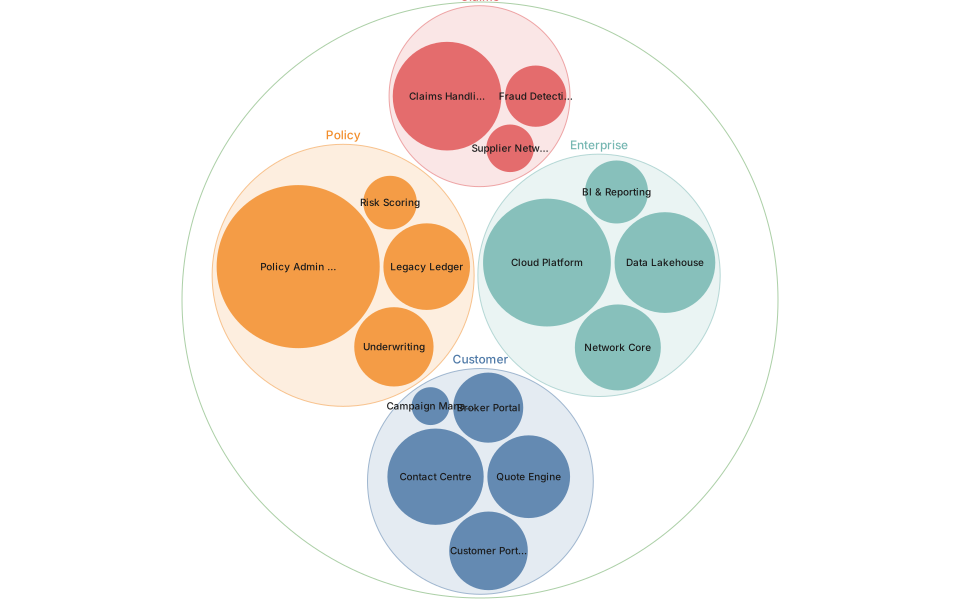
- Format.d3
- Length77 lines
- Includesnone
The source
77 lines of D3 JavaScript, and uses only the bundled D3 build. Copy it, or open the template inside Gnomon and render it as it is.
// Circle packing — nesting where relative *area* is the message.
// Weaker than a treemap for precise comparison, stronger for "which of these
// groups is enormous".

const data = {
  name: 'Portfolio',
  children: [
    { name: 'Customer', children: [
      { name: 'Quote Engine',      value: 1240 },
      { name: 'Broker Portal',     value: 890  },
      { name: 'Customer Portal',   value: 1120 },
      { name: 'Contact Centre',    value: 1680 },
      { name: 'Campaign Manager',  value: 260  },
    ]},
    { name: 'Policy', children: [
      { name: 'Policy Admin Core', value: 4820 },
      { name: 'Legacy Ledger',     value: 1360 },
      { name: 'Underwriting',      value: 1140 },
      { name: 'Risk Scoring',      value: 520  },
    ]},
    { name: 'Claims', children: [
      { name: 'Claims Handling',   value: 2140 },
      { name: 'Fraud Detection',   value: 680  },
      { name: 'Supplier Network',  value: 410  },
    ]},
    { name: 'Enterprise', children: [
      { name: 'Data Lakehouse',    value: 1840 },
      { name: 'BI & Reporting',    value: 720  },
      { name: 'Cloud Platform',    value: 2960 },
      { name: 'Network Core',      value: 1340 },
    ]},
  ],
};

const root = d3.pack().size([width - 4, height - 4]).padding(4)(
  d3.hierarchy(data)
    .sum(d => d.value || 0)
    .sort((a, b) => b.value - a.value),
);

const color = d3.scaleOrdinal(data.children.map(c => c.name), theme.palette);
const topOf = d => d.ancestors().find(a => a.depth === 1)?.data.name ?? '';

const svg = d3.select(container).append('svg')
    .attr('viewBox', [0, 0, width, height])
    .attr('width', width)
    .attr('height', height)
    .attr('font-family', 'system-ui, sans-serif')
    .attr('font-size', 10)
    .attr('text-anchor', 'middle');

const node = svg.append('g')
  .selectAll('g')
  .data(root.descendants())
  .join('g')
    .attr('transform', d => `translate(${d.x + 2},${d.y + 2})`);

node.append('circle')
    .attr('r', d => d.r)
    .attr('fill', d => d.depth === 0 ? 'none' : color(topOf(d)))
    .attr('fill-opacity', d => d.children ? 0.15 : 0.85)
    .attr('stroke', d => d.children ? color(topOf(d)) : 'none')
    .attr('stroke-opacity', 0.5);

// Group names above their circle, leaf names inside — the two never collide.
node.filter(d => d.depth === 1)
  .append('text')
    .attr('y', d => -d.r - 5)
    .attr('fill', d => color(topOf(d)))
    .attr('font-size', 12)
    .text(d => d.data.name);

node.filter(d => !d.children && d.r > 16)
  .append('text')
    .attr('dy', '0.35em')
    .attr('fill', theme.mode === 'dark' ? '#ffffff' : '#1a1a1a')
    .text(d => d.data.name.length > 14 ? d.data.name.slice(0, 13) + '…' : d.data.name);
Render this offline
This template ships in Gnomon and renders on your machine, with no account and nothing sent to a server. The browser editor is free and needs no install.
Others in D3 visualisations
- Sankey — request flowFlow with volume. The best chart here for "where does it all go".
- Chord — service interactionWho talks to whom, when the traffic is bidirectional.
- Arc diagram — dependenciesNodes on one axis, arcs above. Readable where a force graph is not, provided the ordering means something.
- Adjacency matrix — couplingAdjacency matrix. Unfashionable, and better than a force graph for dense dependencies.
- Edge bundling — module importsHierarchical edge bundling. For import graphs big enough that straight edges become a hairball.
- Sunburst — nested spendNested hierarchy, radially. Prettier than an icicle, harder to compare.
- Icicle — nested spend (linear)A sunburst unrolled flat. Harder to love, much easier to compare siblings.
- Treemap — portfolio costNested size. Good for cost, storage, lines of code.
- Tidy tree — structureA tidy tree. The default for anything with one parent per node.
- Radial tree — structure (radial)The same tree bent into a circle. Fits more depth on a slide, costs you easy comparison.
- Dendrogram — clusteringClustering, with join height carrying the distance. Not merely a tree with curves.
- Indented tree — file/spec outlineA file or spec outline. The chart that looks like the thing it describes.
- Force graph — service mapService map. Use for clusters, not for reading individual edges.
- Force graph — disjoint clustersForce graph that keeps unconnected clusters apart rather than flinging them off screen.
- Force graph — radial tiersForce layout pinned to rings, so tier is a position instead of a colour legend.
- Directed graph — call directionDirected edges with arrowheads. For when direction is the question, not just adjacency.
- Force tree — blast radiusBlast radius from one node: what breaks if this goes.
- Calendar heatmap — daily activityDaily activity over a year: deploys, incidents, commits.
- Streamgraph — shifting mixShifting composition over time. Good for the mix, poor for reading any single value.
- Gantt — delivery roadmapDelivery roadmap, rendered from data.
- Radar — capability scoringCapability scoring across axes. Fine for one subject, misleading with four overlaid.
- Bullet chart — target vs actualTarget against actual, in one line. The chart a gauge wishes it were.
- Beeswarm — distribution by groupEvery point, grouped, without the overplotting a strip plot suffers.
- Horizon chart — many series, little spaceMany series in little space. Takes a moment to learn, then very dense.
- Slope chart — before and afterBefore and after, two points, one line each. Devastatingly clear.
- Parallel coordinates — multi-criteriaMulti-criteria comparison: for option analysis.
- Box plot — latency distributionLatency distribution. The chart that shows the tail a mean hides.
- Grouped bar — category comparisonCategory comparison. Unglamorous, and usually the right answer.
- Multi-line — metrics over timeMetrics over time. Keep it under about five series, or switch to horizon.